“Before we begin, who has left their water bottle in the lobby?”
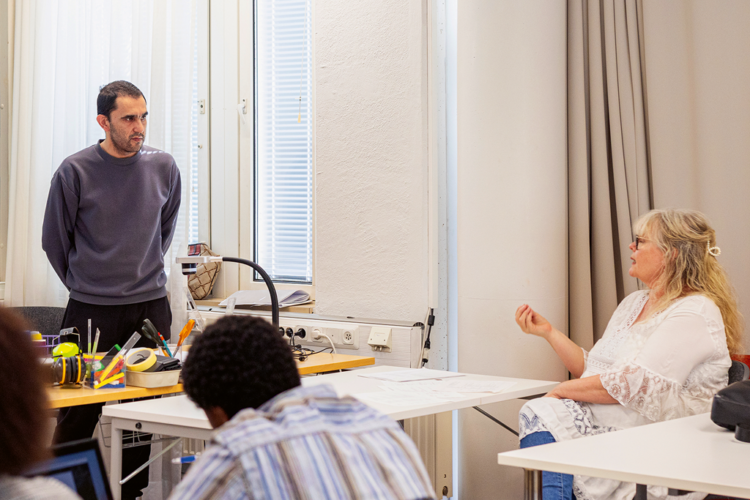
A class on palliative care is beginning at the vocational school Varia, located in Vantaa. A group of 46 future practical nurses, specialising in nursing and elderly care, are gradually taking their seats. It turns out that the water bottle in question belongs to Ali, who has spent the break playing pool in the lobby. After being presented with a sample of explanations on why the exercise for today hasn’t been done, Outi Laitala, senior lecturer in healthcare, opens the class.
“Firstly, we’ll be focusing on the nutrition at the end of palliative care. Abdul, would you take the first turn and come up here?”
Clearing his throat, Abdul Wahid Mohammadyar unfolds his exercise paper in front of the class. At 39 years old, he has been living in Finland since 2015. Abdul has done his professional training at a children’s daycare centre and in elderly care. At the latter, he also learnt palliative care. For him, today’s topic is two-sided. It is routine but also brings up emotions.
“Meeting people is the best part of this work,” Abdul says later in the hallway.
He has had an education in business, but the field does not interest him. For Abdul, it’s people and their stories. Though very challenging, the future profession of a practical nurse is extremely important.
“While doing palliative care, I was there for the final moments of a person’s life. I wasn’t prepared for the sadness of death. It was the first time I saw a dying person.”
No Fear of Speaking Up
In front of the class, Abdul recites in a calm tone:
“A supported posture while consuming food, pureeing food if necessary, nutritional supplements, Nutridrink, perhaps also some medicine to stimulate the appetite?”
Outi gives praise to Abdul for his answer.

“But for the corticosteroids, those should be administered earlier on by a doctor. In this exercise we’ll concentrate on the final weeks of palliative home care. It is a part of the process of dying that one loses one’s appetite.”
“And the posture for sitting?” a woman from the front row asks.
Ojeh Obichukwu, 28, raises her hand several times during the class. She has endless empathy for teachers, as she herself is an English teacher by profession.
“I have a very low tolerance for silence during class. Shared conversations are what help me learn.”
Ojeh seems to hold the best Finnish language skills in the class, the small handful of native speakers excluded.
“It is unfortunate that our language skills are at this level, although we are so close to graduation,” Ojeh criticises.
Coming from Delta State, Nigeria, Ojeh has recently moved from Kouvola to Helsinki. She has trained at elderly homes and most recently at a respiratory care unit.
“The last training period was the most demanding and different from them all. I’ve also done a lot of temp work as a practical nurse, which is challenging. I was motivated for this field of work by the kindness the elderly people showed me right after I had arrived in Finland.”
Currently, Ojeh dreams of someday becoming a radiographer.
“Outi is one of my favourite teachers. She has the patience to explain subjects in a calm and clear way.”
Going Back to School Takes Motivation
A pile of noise-cancelling headphones has gathered on the teacher’s desk. The large classroom also serves as a library and can get quite lively. A massage chair hides behind a curtain. Students are welcome to relax in it on breaks.
A few people are fiddling with their phones during class. Someone opens their camera to fix their lip liner. Nearly everyone is taking notes.
Only a small number in the class speak Finnish as their first language. Most of the non-native speakers have arrived in the country as adults. Many already have degrees and professions. It is a fine thing, Outi states. If it were up to her, Finland would encourage adults to reeducate themselves. Currently, the field is missing motivated adults who have a clear will and way for their new profession, as the support system for adult education has been discontinued by the current government.
Simple Words, Big Impact
Teaching needs to adjust when a majority of the class has Finnish as their second language. An S2 teacher specialised in pedagogy for people with Finnish as a second language accompanies the students in many of the classes. They also teach a class for students struggling with the language.
“The emphasis is on clarifying the home care competency requirements and on practising phone calls, so that language skills do not become a barrier to interaction.”
Medication is explained in a clear and deliberate way.
“I’ve decided on not mentioning doses, as they tended to stick in students’ minds as constants. It’s better to emphasize that medications are given as the doctor orders them.”
Outi takes her time and uses synonyms when teaching.
“Remember, the sitting posture is at a 90-degree angle. That will prevent aspiration. This is important so that your patient will be able to swallow properly and liquids will move down easily. Swallowing difficulties are a common symptom. Pay attention to this while they are eating. A good sitting position is important during meals.”
Between Home, Work and School Runs
The discussion on appetite and nutrition is coming to an end. Outi takes the class in and asks if anyone wants to add anything else.
Stephanie Emenuga, 35, lifts her hand.
“There should be peace and quiet while they are eating. No rushing.”
Stephanie says she is used to taking part in palliative care. She works in a care unit in Koivukylä and is finishing her studies through apprenticeship training. She is living through the busiest years of her life with work, studies, and small children at home.
“I feel like I’m constantly running between home, work, and school. Elderly people remind me of children, working with them requires patience, humility, and acceptance,” she says.
Born in Imo State, Nigeria, Stephanie worked at a café after high school.
“This career means a lot more responsibility. People really depend upon you. I love it and I hope to continue my studies. The best moments are when I connect with a person suffering from dementia. Even though they will not remember me tomorrow, for that short moment, we are there together.”
At Heart, a Nurse
Varia still offers in-person teaching, Outi says. It’s important as the students have a hunger for work-life confidence and skills. The closer the students are to finishing school, the more they long for hands-on practice that would give them self-assurance in working life.
“SuPer also visits our school regularly to give the students information on their rights and work-life rules.”
Outi worries about the challenges the graduates will face.
“My hope is that working life would still hold space for people who are nurses at heart.”
This year’s reporting on the crisis of elderly care has clearly affected students’ expectations and attitudes. Many worry about the ethical problems their career might bring about.
“We are in need of a conversation about structures and what should change in them, instead of blaming individuals,” Outi says.
Doing the Right Thing
The class is coming to an end. Imagine that you are entering their room, Outi prompts.
While teaching, she uses a lot of examples from her own working life. Outi graduated as a nurse in 1993 and has been working as a teacher since 2008. She looks at the students.
“You are nurses now. You are in the room and Martta is in palliative care. She has vomited. How will you take care of her? What is the first thing you’ll do?”
“Hydration and cleaning the mouth,” Stephanie says.
“The sheets,” Ojeh adds.
“Very well. And if someone suggests that sheets or clothes should not be changed that often, you will do no such thing as listen to them. In palliative care, the most important thing is that the person in your care is fresh and clean,” Outi says.
I want to bring up nurses who are ethically responsible, she says later. The gist of teaching for Outi is the possibility to make the future of nursing better, and to weed out practices that have been found ineffective.
“Change happens when graduates enter the field. Today experienced nurses might still be mixing medicine into warm food, but the newly qualified nurses will decline to do so. They know better.”
Studies are increasingly flexible
Becoming a practical nurse is now a possibility to even more people, as the study programmes are more adaptable. Studies can be started and completed according to an individual schedule or as part of an apprenticeship. The Vocational Qualification in Social and Healthcare provides the same basic education for everyone. This is followed by several competence areas, such as mental health and substance abuse work, early childhood education and care, nursing, disability services, and care and rehabilitation for older people.
Additional reads: Emma Holten wants to show us how economics has failed care work